Cognitively Guided Instruction, a research-based approach, profoundly impacts elementary mathematics education, fostering deeper understanding and problem-solving skills for students of all levels.
What is Cognitively Guided Instruction?
Cognitively Guided Instruction (CGI) is a problem-solving approach to mathematics education rooted in understanding how children naturally think about and solve arithmetic problems. It doesn’t prescribe specific teaching methods, but rather emphasizes building upon students’ existing knowledge and mental strategies.
CGI focuses on identifying the underlying cognitive structures children use when tackling mathematical tasks. This involves observing students’ thinking processes, recognizing their strategies, and then providing opportunities to refine and extend those strategies. The goal isn’t simply to get the right answer, but to understand how a student arrived at that answer, and to foster flexible and efficient problem-solving abilities.
Essentially, CGI aims to mirror the way humans naturally reason mathematically, promoting conceptual understanding over rote memorization.
Historical Development of CGI
Cognitively Guided Instruction (CGI) emerged from the extensive research conducted at the University of Washington, beginning in the 1980s. Initially, researchers focused on understanding adults’ mental arithmetic, revealing a surprisingly consistent set of strategies used across individuals.
This work then shifted to examining children’s mathematical thinking, discovering that even young students possess sophisticated, though often unarticulated, problem-solving approaches. Over the past two decades, CGI has had a massive impact on elementary mathematics education, evolving from a research project into a widely adopted instructional framework.
The ongoing refinement and dissemination of CGI principles continue to shape best practices in mathematics teaching today.
Key Researchers in CGI
Dr. Kendra Lomax, from the University of Washington, stands as a prominent figure in contemporary CGI research and implementation. Her work focuses on translating the core ideas of CGI into practical classroom strategies for educators. Prior foundational research was spearheaded by Thomas Carpenter, Elizabeth Fennema, and Megan Franke, whose initial investigations into adult and children’s mathematical thinking laid the groundwork for CGI.
These researchers meticulously documented the diverse strategies individuals employ when solving arithmetic problems, revealing underlying cognitive structures. Their collaborative efforts established CGI as a robust and evidence-based approach to mathematics instruction, influencing countless teachers and students.

The Core Principles of CGI
CGI centers on understanding how children naturally think about mathematics, building upon existing knowledge, and prioritizing mental math strategies for flexible problem-solving.
Understanding Children’s Thinking

A cornerstone of CGI is deeply understanding students’ existing mathematical thinking. This involves recognizing that children enter classrooms with pre-existing strategies for solving problems, even if those strategies aren’t formally taught. Teachers utilizing CGI actively observe and analyze student approaches to uncover these underlying thought processes.
This isn’t about correcting “wrong” answers immediately, but rather about identifying how a student arrived at their solution. Understanding these cognitive strategies – whether they involve counting, using known facts, or visualizing – allows educators to build instruction that connects to what students already know.
By valuing and leveraging this existing knowledge, CGI fosters a more intuitive and meaningful learning experience, promoting conceptual understanding over rote memorization.
Building on Existing Knowledge
CGI emphasizes that new mathematical concepts should be presented as extensions of students’ current understanding. Rather than introducing abstract rules, teachers connect new ideas to the strategies children already employ. This approach acknowledges that learning is a progressive process, building upon prior knowledge and experiences.
For example, if a student consistently uses counting on to solve addition problems, the teacher might introduce the concept of using a number line to represent that same strategy visually.
This builds a bridge between the familiar and the new, making the learning process more accessible and reinforcing the idea that mathematics is logical and interconnected.
The Role of Mental Math
Mental math is central to Cognitively Guided Instruction, serving as a crucial bridge between concrete experiences and abstract understanding. CGI encourages students to develop flexible and efficient mental strategies for computation, rather than relying solely on rote memorization of procedures.
This focus on mental strategies allows students to internalize number relationships and develop a deeper conceptual grasp of mathematical operations.
Teachers facilitate this by posing problems that encourage students to think aloud and share their reasoning, fostering a classroom culture where mental computation is valued and refined.
CGI and Problem-Solving Strategies
CGI emphasizes diverse problem-solving approaches like direct modeling, acting out, and counting on, nurturing flexible thinking and conceptual understanding in young mathematicians.
Direct Modeling
Direct modeling, a foundational strategy within Cognitively Guided Instruction (CGI), involves students using concrete objects or drawings to represent the quantities and actions described in a word problem. This hands-on approach allows children to directly recreate the scenario, fostering a deep understanding of the relationships between numbers and operations.
Initially, students might use physical manipulatives like counters or cubes. As their understanding grows, they transition to drawing pictures or diagrams to represent the problem. This visual representation helps solidify their thinking and makes the abstract concepts more accessible. Direct modeling is particularly effective for early learners as it connects mathematical ideas to their real-world experiences, building a strong conceptual base for future mathematical learning.
Acting Out
Acting out, a powerful strategy within Cognitively Guided Instruction (CGI), encourages students to physically embody the actions described in a word problem. This kinesthetic approach is particularly beneficial for learners who benefit from movement and hands-on experiences. By becoming the “characters” in the problem, students gain a deeper, more intuitive understanding of the mathematical relationships involved.
For example, if a problem involves students joining or separating groups, children can physically act out these actions. This method helps them visualize the process and connect it to the corresponding mathematical operation. Acting out is especially useful for story problems, making them more engaging and memorable, ultimately strengthening their problem-solving abilities.
Counting On
Counting on, a fundamental strategy within Cognitively Guided Instruction (CGI), represents a crucial step in developing fluency with addition and subtraction. This method involves starting with the larger number in an addition problem and then counting upwards to reach the total. Conversely, in subtraction, students begin with the larger number and count backwards to determine the difference.
CGI emphasizes that children naturally develop this strategy as they build number sense. Teachers facilitate this by encouraging students to verbalize their counting process and connect it to the problem’s context. Mastering ‘counting on’ builds a strong foundation for more complex arithmetic and fosters mental math proficiency, essential for future mathematical success.
Developing Flexible Strategies
Developing flexible strategies is central to Cognitively Guided Instruction (CGI). It moves beyond memorizing procedures to understanding why a strategy works, allowing students to choose the most efficient approach for each problem. CGI encourages students to utilize their existing knowledge and invent solutions, rather than relying on a single, prescribed method.
This adaptability is fostered by exploring various representations – like using number lines, drawings, or mental math – and discussing different solution paths. Teachers act as facilitators, prompting students to explain their reasoning and connect strategies to number relationships. Ultimately, flexible thinking empowers students to become confident and resourceful problem-solvers.
Implementing CGI in the Classroom
Effective implementation requires assessing student thinking, planning lessons that build on existing knowledge, and using targeted prompts to guide their mathematical reasoning.
Assessing Student Thinking
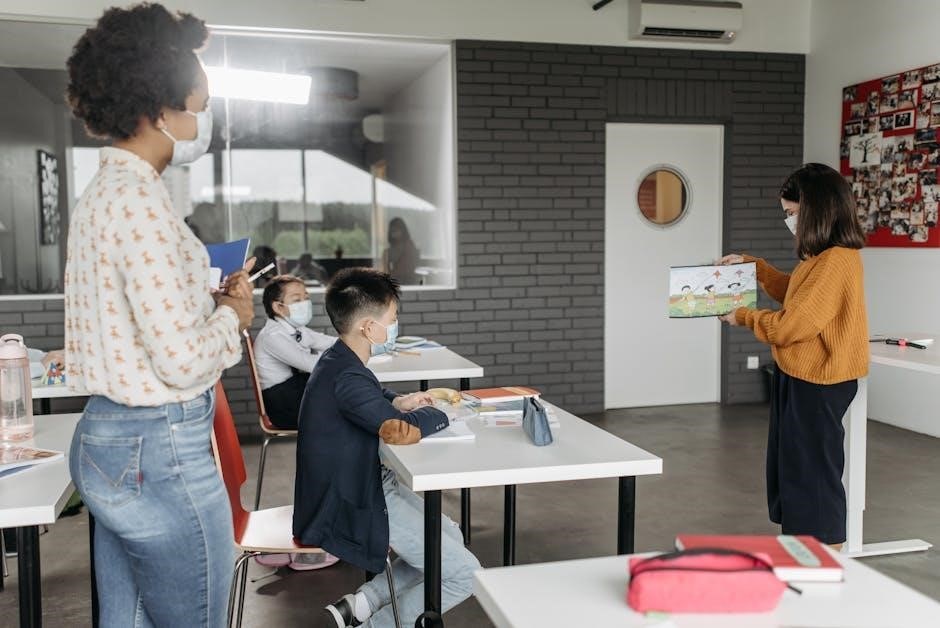
Central to CGI is understanding how students arrive at their answers, not just if they are correct. Teachers actively listen to student explanations, observe their strategies, and analyze their work to identify their current levels of understanding. This formative assessment informs instructional decisions, allowing educators to tailor lessons to meet individual needs.
Monitoring prompts, as highlighted by IM K5 Math, are crucial for observing student work during lessons. This allows teachers to uncover student learning and make adjustments based on their comprehension. The goal isn’t simply to correct errors, but to build upon existing cognitive strategies and guide students toward more sophisticated problem-solving methods.
Planning Lessons with CGI in Mind
Effective CGI lesson planning begins with anticipating the diverse solution strategies students might employ. Teachers don’t predetermine the “right” way to solve a problem, but rather prepare to support a range of approaches. Lessons are designed to elicit student thinking and provide opportunities for sharing and discussion.
IM K5 Math emphasizes that lesson syntheses are vital for uncovering student learning. Activities should be structured to allow students to share their developing thinking and advance towards the lesson goals. Planning also involves considering how to connect new concepts to students’ existing knowledge, fostering a deeper, more meaningful understanding.
Using Prompts to Guide Student Thinking
Strategic prompting is central to CGI, helping teachers understand and build upon students’ existing mathematical reasoning. Instead of directly telling students how to solve a problem, prompts encourage them to articulate their thinking processes and justify their solutions. These prompts, as highlighted by IM K5 Math, monitor for student work and guide instructional adjustments.
Advancing Student Thinking questions are crucial, supporting students to share their developing ideas and progress towards learning goals. Effective prompts aren’t leading questions, but rather invitations for students to elaborate on their strategies and explain their reasoning, fostering a deeper conceptual understanding.
Lesson Synthesis and Student Learning
Lesson synthesis, a cornerstone of CGI, involves teachers carefully analyzing student work to uncover patterns in their thinking and identify common strategies. As emphasized by IM K5 Math, this process provides space for both teachers and students to share their learning and insights. It’s not simply about finding the “right” answer, but understanding the diverse approaches students employ.
This reflective practice informs future instruction, allowing teachers to address misconceptions and build upon existing knowledge. Student-led sharing of strategies is also vital, promoting peer learning and solidifying conceptual understanding. Synthesis reveals what students truly understand, guiding instructional adjustments.

CGI and Different Grade Levels
CGI adapts to various ages, offering tailored support; summer math reviews reinforce skills, preparing students for the next grade band’s challenges and concepts.
CGI in Kindergarten and First Grade
In the earliest grades, Cognitively Guided Instruction focuses on building a strong foundation through concrete experiences and informal strategies. Teachers observe how young learners naturally approach problems, recognizing their emerging understanding of number relationships. Emphasis is placed on developing counting skills, subitizing (instantly recognizing quantities), and utilizing mental math strategies like counting on.
The goal isn’t to impose a specific method, but to nurture children’s inherent mathematical thinking. Activities often involve acting out problems with manipulatives or drawing pictures to represent situations. This allows students to connect mathematical concepts to real-world scenarios, fostering a deeper and more meaningful comprehension of foundational arithmetic principles.
CGI in Second and Third Grade
As students progress to second and third grade, CGI builds upon the foundational skills established earlier. The focus shifts towards developing more sophisticated problem-solving strategies, such as using known facts to derive unknown ones and employing compensation techniques. Teachers continue to prioritize understanding children’s thinking, prompting them to explain their reasoning and justify their solutions.
Students begin to explore more complex problem types, including those involving addition and subtraction with larger numbers. Emphasis is placed on developing fluency with basic facts and utilizing these facts to solve multi-step problems. The goal remains to foster conceptual understanding and flexible thinking, rather than rote memorization of procedures.
CGI in Fourth Grade and Beyond (Grade Bands)
Extending CGI principles into fourth grade and beyond involves adapting strategies to accommodate increasingly complex mathematical concepts. The focus transitions to multi-digit operations, fractions, and decimals, while maintaining the core emphasis on student thinking and reasoning. Grade bands, like the summer math programs, review skills from the previous year, ensuring continuous progress.
Teachers continue to facilitate discussions, encouraging students to share their approaches and critique the reasoning of others. The zone of proximal development is crucial, providing appropriate support to challenge students and foster growth. CGI supports building on existing knowledge, enabling students to tackle advanced problems with confidence.

The Benefits of Using CGI
CGI cultivates improved problem-solving, deeper conceptual understanding, and heightened student engagement by prioritizing children’s mathematical thinking and building upon their existing strategies.
Improved Problem-Solving Skills
Cognitively Guided Instruction (CGI) significantly enhances students’ abilities to tackle mathematical problems effectively. By focusing on understanding how children think about math, CGI encourages the development of flexible strategies rather than rote memorization of procedures. Students learn to analyze problems, select appropriate methods, and justify their reasoning.
This approach moves beyond simply finding the correct answer; it emphasizes the process of problem-solving itself. Through activities like direct modeling and acting out, students build a strong foundation for tackling increasingly complex challenges. CGI fosters a deeper, more resilient understanding of mathematical concepts, empowering students to become confident and capable problem-solvers.
Increased Conceptual Understanding
Cognitively Guided Instruction (CGI) prioritizes a deep, conceptual grasp of mathematical principles over procedural fluency. Instead of merely teaching how to solve problems, CGI explores why those methods work, building upon children’s existing knowledge and intuitive understanding. This approach allows students to connect new concepts to their prior experiences, creating a more robust and meaningful learning experience.
By focusing on mental math and various problem-solving strategies, CGI encourages students to internalize mathematical relationships. This fosters a richer, more interconnected understanding of numbers and operations, moving beyond surface-level memorization towards genuine mathematical comprehension and lasting retention.
Enhanced Student Engagement
Cognitively Guided Instruction (CGI) dramatically boosts student engagement by valuing and building upon their natural mathematical thinking. When students are encouraged to share their strategies and reasoning, a collaborative and supportive classroom environment emerges. This approach acknowledges that there are multiple pathways to a solution, fostering confidence and a willingness to take risks.
CGI’s focus on problem-solving, rather than rote memorization, makes mathematics more relevant and appealing. Students become active participants in their learning, driven by curiosity and a desire to understand, leading to increased motivation and a more positive attitude towards mathematics.
CGI and Curriculum Integration
Integrating CGI with existing math programs, like IM K5 Math, provides teachers with prompts and syntheses to uncover and support student learning effectively.
Integrating CGI with Existing Math Programs
Successfully blending Cognitively Guided Instruction (CGI) into current math curricula requires a thoughtful approach. Resources like IM K5 Math offer valuable support, providing teachers with tools to monitor student thinking during lessons. These tools include carefully crafted prompts designed to guide activity planning and lesson synthesis, helping educators pinpoint key insights from student work.
Advancing Student Thinking questions further empower teachers to facilitate discussions and encourage students to articulate their developing reasoning. Importantly, lesson syntheses create dedicated spaces for uncovering student learning and fostering shared understanding. Finally, Response to Student Thinking suggestions assist teachers in making informed instructional adjustments, ensuring continuous growth based on individual student needs and comprehension.
Using IM K5 Math to Support CGI
IM K5 Math significantly enhances the implementation of Cognitively Guided Instruction (CGI) by providing targeted resources for teachers. The platform’s prompts are instrumental in planning activities and synthesizing lessons, guiding educators to observe and interpret student work effectively. These prompts focus attention on crucial aspects of student thinking, allowing for more informed instructional decisions.
Furthermore, Advancing Student Thinking questions within IM K5 Math encourage students to share their reasoning and progress towards learning goals. The platform’s lesson and activity syntheses offer dedicated spaces to analyze student understanding, while Response to Student Thinking suggestions facilitate dynamic adjustments to instruction based on observed comprehension levels.
Challenges and Considerations
Effective CGI implementation requires robust teacher training, addressing diverse learning needs, and understanding the Zone of Proximal Development to maximize student growth.
Teacher Training and Professional Development
Successful integration of CGI hinges on comprehensive teacher training and ongoing professional development. Educators need deep understanding of children’s mathematical thinking, moving beyond simply delivering procedures to facilitating conceptual understanding. This involves learning to accurately assess student strategies, crafting purposeful prompts, and skillfully guiding classroom discussions.
Training should focus on recognizing the diverse ways students approach problems, interpreting their reasoning, and providing targeted support within their zone of proximal development. Furthermore, professional development must create opportunities for teachers to collaborate, share insights, and refine their practice, ensuring sustained and effective implementation of CGI principles within their classrooms.
Addressing Diverse Learning Needs
CGI’s flexibility inherently supports addressing diverse learning needs. By focusing on students’ existing cognitive strategies, CGI allows teachers to meet learners where they are, building upon their current understanding. This approach is particularly beneficial for students who may struggle with traditional methods or have gaps in their foundational knowledge.
Effective implementation involves differentiating instruction through carefully crafted prompts and tasks, providing appropriate scaffolding, and fostering a classroom environment where all students feel comfortable sharing their thinking. Recognizing and valuing diverse approaches to problem-solving ensures equitable access to mathematical learning for every child.
The Zone of Proximal Development in CGI
CGI aligns perfectly with Vygotsky’s concept of the Zone of Proximal Development (ZPD). This zone represents the gap between what a student can do independently and what they can achieve with guidance. CGI aims to operate within this sweet spot, presenting challenges that stretch students’ cognitive abilities while remaining accessible with appropriate support from the teacher and peers.
By carefully observing student thinking and providing targeted prompts, teachers facilitate learning within the ZPD, fostering growth and independence. This approach ensures students are consistently engaged in activities that promote optimal learning and cognitive development.

Resources for Learning More About CGI
Explore valuable resources from The Math Learning Center, University of Washington research, and New York State Migrant Education Program materials to deepen your CGI understanding.
The Math Learning Center Resources
The Math Learning Center (MLC) provides extensive support for educators seeking to implement Cognitively Guided Instruction (CGI) effectively. Dr. Kendra Lomax, from the University of Washington, highlights the significant impact CGI has had on elementary mathematics over the past two decades, and MLC offers practical tools to translate these “big ideas” into classroom practice;
MLC’s resources include professional development materials, articles, and videos demonstrating CGI principles in action. These resources focus on understanding children’s mathematical thinking and building upon their existing knowledge. They offer guidance on facilitating student discourse and creating a learning environment where students can confidently share and refine their strategies. MLC’s commitment to CGI empowers teachers to foster a deeper conceptual understanding of mathematics in their students.
University of Washington Research
The University of Washington stands as a pivotal center for Cognitively Guided Instruction (CGI) research and development. Dr. Kendra Lomax, a prominent figure from the University, actively contributes to advancing the understanding and implementation of CGI in elementary mathematics education. Their work emphasizes the importance of aligning instruction with children’s natural mathematical thinking.
Research from the University focuses on identifying common cognitive strategies children employ when solving math problems. This knowledge informs instructional practices, enabling teachers to build upon existing student understanding and guide them towards more sophisticated problem-solving methods. The University’s ongoing research continues to refine and expand the principles of CGI, ensuring its relevance and effectiveness in modern classrooms.
New York State Migrant Education Program Materials
The New York State Migrant Education Program provides valuable resources supporting Cognitively Guided Instruction (CGI) implementation, particularly focusing on reinforcing math skills during summer programs. These materials are specifically designed to review concepts learned throughout the academic year, preventing learning loss and preparing students for the next grade level.
The program’s “Grade Bands” approach ensures students receive appropriate practice based on their completed grade, rather than their current enrollment. For instance, a student finishing fourth grade would utilize materials geared towards that level, aiding in retention and building a strong foundation for fifth-grade mathematics. These resources emphasize word problems, aligning with CGI’s focus on real-world application.